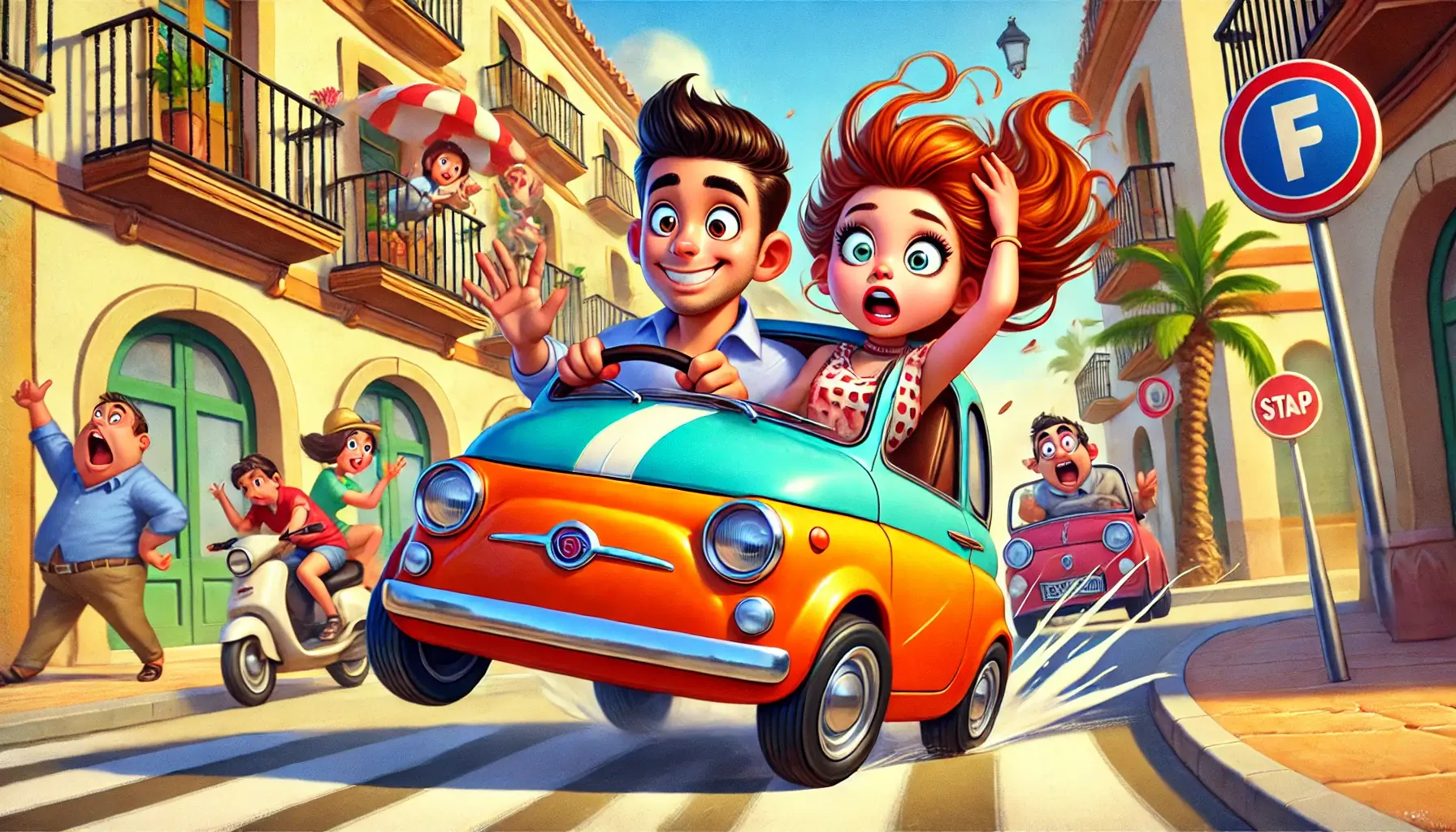
I believe there are two options in life: you either laugh at the mishaps you make, or you cry. But in the end, after a while, you end up laughing anyway. You simply must; otherwise, life will get the better of you.
Most of the time, it’s me who gets into trouble, but the other day, it was my husband who starred in our “personal scary movie”.
We travel a lot by car because we like exploring new places. Once we arrived in Murcia, Spain. We parked, went for a walk, ate amazing food, visited some picturesque places, and returned to the car park ready to leave. I put the directions on, and off we went.
We took the first turn, drove a couple of metres, and that’s when it happened.
Realisation
We must be going the wrong way! This can’t be right – why are all the cars facing us?
Have you ever felt your heart stop? Try turning the wrong way into oncoming traffic, and I can guarantee you will experience the same feeling. I may have said some words that weren’t very polite, but who wouldn’t? The silence in the car was heavy. Then, we locked eyes with an elderly couple who were waiting at the red light. Their expressions mirrored ours: wide eyes, open mouths. I could almost hear their screams, mixing with my own internal shriek.
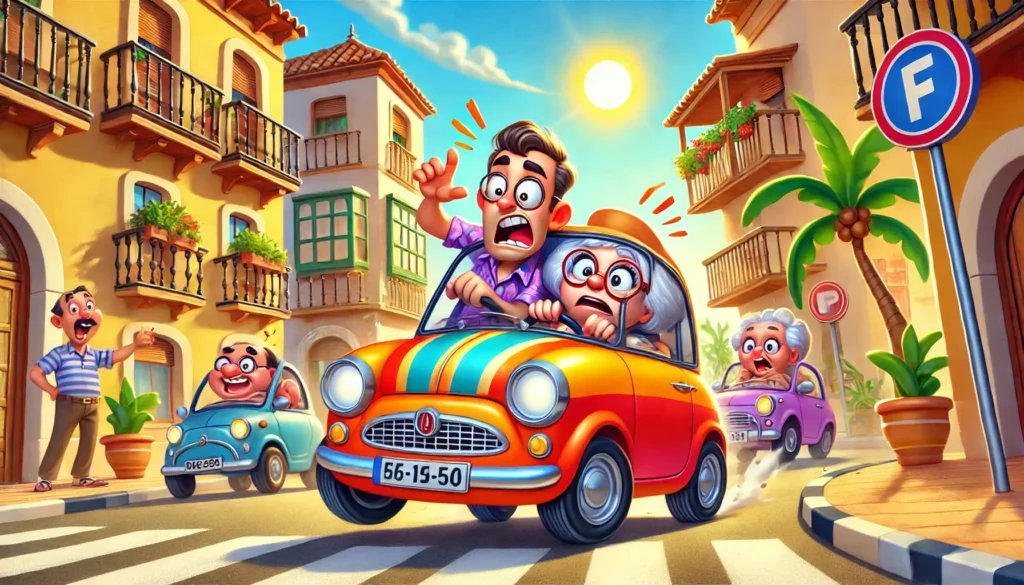
Suddenly it all became clear. That’s why the road had been empty. All the cars were stopped at the traffic light, patiently waiting. They must have been in shock when they saw our car suddenly facing them. We might have missed the sign!
Fast and Furious
If the light stays red, we’ll have time to reverse. And as if my husband, whom I would not have called “darling” at that time, read my mind, he put the car into reverse and sped backwards to where we had come from. At that moment, I was sure that in his previous life, he had been a Formula 1 driver. Thank God! The minute we were back in our lane, the cars started moving. We were lucky. My husband was lucky. You can’t possibly imagine the earful he would have got if it had ended differently. Also, he was lucky I was not some horrid wife who would be shouting at him all the way home.
All the possibilities were racing through my head. If the cars had started moving a second earlier, we would have crashed. If the cars hadn’t been stopped at the red light, we wouldn’t have taken the wrong turn, because we would have seen the traffic. If the maps had been updated, we would have known there was a diversion. If he hadn’t been such a good driver, we would definitely have crashed. So many ifs!
Once we were safe on the road, heading in the right direction, I just muttered, “Why can’t you just watch the Fast and Furious movie? Why do you also need to participate in one?”
📘 Phrase Glossary
| Word / Expression | Meaning (B1-friendly) |
|---|---|
| mishaps | small mistakes or accidents |
| personal scary movie | a frightening experience, like being in a horror film |
| picturesque | very beautiful, like a picture |
| oncoming traffic | cars coming towards you on the road |
| shriek | a loud, high cry or scream |
| earful | a strong telling-off; being scolded |
| diversion | when the normal road is closed and you must take another route |
❓Quiz Time
🎯True or False
🧠 Grammar explained – Modals
Modals in the text
Modals are auxiliary verbs that express ability, possibility, necessity, obligation, or probability. In your text, several modals appear:
| Sentence from text | Modal | Function / Meaning |
|---|---|---|
| You simply must; otherwise, life will get the better of you. | must | expresses strong necessity/obligation |
| We must be going the wrong way! | must | expresses deduction or logical conclusion |
| This can’t be right – why are all the cars facing us? | can’t | expresses impossibility or disbelief |
| I may have said some words that weren’t very polite | may have | expresses possibility in the past |
| They must have been in shock | must have | expresses deduction about the past |
| He would not have called “darling” at that time | would not have | expresses past hypothetical behaviour |
| We would definitely have crashed | would have | expresses certainty in a hypothetical past situation |
| You can’t possibly imagine the earful he would have got | can’t | expresses impossibility |
Tip: Modals in the past often combine with “have + past participle” to talk about past possibilities, deductions, or hypothetical situations.
🧠 Grammar explained – Conditionals
Conditionals are “if sentences”. They show what can happen, could happen, or could have happened.
1. First conditional – real future possibilities
Structure: If + present simple, … will + verb
Use: Something possible in the future.
Example from the story:
- If the light stays red, we’ll have time to reverse.
Meaning: It is possible that the light will stay red, and if it does, we will have time to reverse.
2. Second conditional – unreal present or future
Structure: If + past simple, … would + verb
Use: Something imaginary or unlikely now or in the future.
Example from the story:
- Also, he was lucky I was not some horrid wife who would be shouting at him all the way home.
Meaning: I am not a horrid wife, but if I were, I would shout at him.
Tip: Use second conditional to talk about things that are not real now or probably won’t happen.
3. Third conditional – unreal past
Structure: If + past perfect, … would have + past participle
Use: Something imaginary in the past; it did not happen.
Examples from the story:
- If the cars had started moving a second earlier, we would have crashed.
- If the maps had been updated, we would have known there was a diversion.
Meaning: These events didn’t happen, but we imagine what could have happened.
Quick visual guide (B1 level)
| Conditional | Form | Example | Meaning |
|---|---|---|---|
| First | If + present, … will | If the light stays red, we will have time to reverse. | Real possibility in the future |
| Second | If + past, … would | If I were a horrid wife, I would shout at him all the way home. | Unreal / imaginary now or future |
| Third | If + past perfect, … would have | If the cars had started moving earlier, we would have crashed. | Unreal / imaginary in the past |
🤓 Time for Grammar practice
✍️ Writing Practice
Mixed Conditionals (challenge!)
Write a short story (8–10 sentences) that uses all three conditionals at least once.
👉 Example starter: If the bus comes on time, I will… If I were more organised, I would… If I had checked the timetable, I would have…
Ask your AI to review it using this prompt:
“Please review my writing. Check if I used the first, second, and third conditionals correctly. Tell me if the verb tenses are right (present, past, past perfect). Also, explain any mistakes in simple words and give me one corrected example sentence for each mistake. Finally, tell me if my sentences are clear and natural for B1 level.”
🤖Ask AI for help
Prompt for AI (to practise more conditionals)
“Please give me 10 practice sentences using the first, second, and third conditionals. Mix them so I can practise identifying the type. Leave a blank space for the verb so I can fill it in. After I try, check my answers and explain any mistakes in simple words.”
📝 What You Practised in This B1 English Story
In this B1 English story about a driving mishap in Murcia, Spain, you practised both grammar and vocabulary while following a funny real-life adventure. The main grammar focus was on modals of deduction (must, can’t, might, could have) and conditionals (first and third conditionals), which are essential at the B1 level.
You also learned useful travel and everyday vocabulary, such as mishaps, picturesque, oncoming traffic, shriek, diversion, and earful. With the glossary, comprehension quiz, and grammar exercises, you reviewed and tested your knowledge in context.
This short graded reader helped you:
- Improve your English reading comprehension at B1 level
- Practise grammar in context
- Build vocabulary for real-life situations
- Learn English through funny, true stories
If you enjoyed this lesson, explore more of our B1 English stories to continue improving your grammar, vocabulary, and confidence.
Learn English in a fun way. You can check Hilarious Grammar Bites and more English Graded Stories!
