„Je všetko v poriadku?“ asked Peter, with a worried look on his face.
„Áno, všetko je v poriadku. Tvoja sestra je milá. Učí ma po slovensky.“ I replied.
„Ty už predsa vieš po slovensky.“
„Neviem dobre.“
„Ale vieš!“ he kept assuring me that my Slovak was good.
Už som hladná (I’m already hungry)
„Už som hladná,“ announced Jana and turned to me. „Aj ty si hladná?“
„Áno, aj ja som hladná. Aj Peter je hladný.“
„Mamka, daj nám už jesť, sme hladní.“
Suddenly, his mum stood up.
„Joj, prepáčte. Sárinka, dáš si polievku?“
I looked at Peter and could not help smiling. Sárinka, the familiar nickname. Slovaks simply love making nicknames. They call Peter Peťko. Jana is Janka, Eva is Evka, and Ivan is Ivko. This always makes me giggle.
„Áno, prosím si.“
„Prosíš si chlebík? Je čerstvý z obchodu.“
She passed me a basket of bread, still warm. Chlebík, again a diminutive of chlieb (bread). Slovak is full of diminutives: vodička instead of voda (water), kávička instead of káva (coffee), and even vínko instead of víno (wine).
„Nie, ďakujem.“ I shook my head.
„Dobrú chuť, moja.
„Ďakujem, dobrú chuť.“
Tajomstvo cesnačky (The secret of garlic soup)
„Máš rada cesnačku?“ Jana pulled me by the sleeve.
„Prosím?“
I had no idea what cesnačka was.
„Cesnačka je cesnaková polievka.“
„Čo je cesnaková polievka?“
“It’s garlic soup,” Peter explained.
„Aha, áno, mám.“
„Ja ju nemám rada. Je hnusná. Fuj!“
She whispered her dislike of garlic soup in a weak attempt to keep her mum from hearing her.
„Janka, počujem ťa,“ exclaimed her mother.
„Zatvor už tie ústa a jedz,“ ordered her father.
„Čo to znamená? Nerozumiem.“ I asked Peter.
“He literally said, ‘Close your mouth and eat,’” Peter laughed. “It’s a typical parent’s phrase when they are trying to make a child eat.”
„Naberiem ti ešte, Sárinka?“ Eva asked, pointing at my plate.
„Nie, ďakujem.“
I looked at Jana, who was trying to kill the soup just by looking at it.
„Daj sem.“
Peter quickly swapped his empty plate for Jana’s half-full one, making sure Mum did not notice.
After the soup, the second dish was served.
„Kto si prosí kurací rezeň?“
„Ja chcem dva!“ Jana shouted.
She clearly loved schnitzel.
„Prosím si, Janka. Nehovor ‚Ja chcem‘.“ Eva corrected the little girl’s manners.
I had already learned that chcem means I want, while prosím si means I would like.
„Aj ja si prosím,“ I added.
„Prosíš si ryžu, zemiaky alebo hranolky?“
„Daj si zemiaky,“ recommended Peter.
I had already noticed it. Slovaks love potatoes, and they make them in a hundred different ways.
„Nalejem ti pivo, víno alebo džús?“ asked Ivan, Peter’s dad.
„Vodku máte? Som smädná.“
„Vodku?“ Ivan raised his eyebrows.
„Vodu, otec. Myslela vodu.“
Oh crap. Did I just ask for vodka instead of water?
“Yep,” Peter laughed.
„VODU. Prosím si vodu!“ I corrected myself, red-faced.
„Samozrejme, že máme,“ said Ivan as he poured me a glass of water, trying hard not to laugh.
Ešte si dám (I’ll have some more)
There was so much food that I thought I was going to explode.
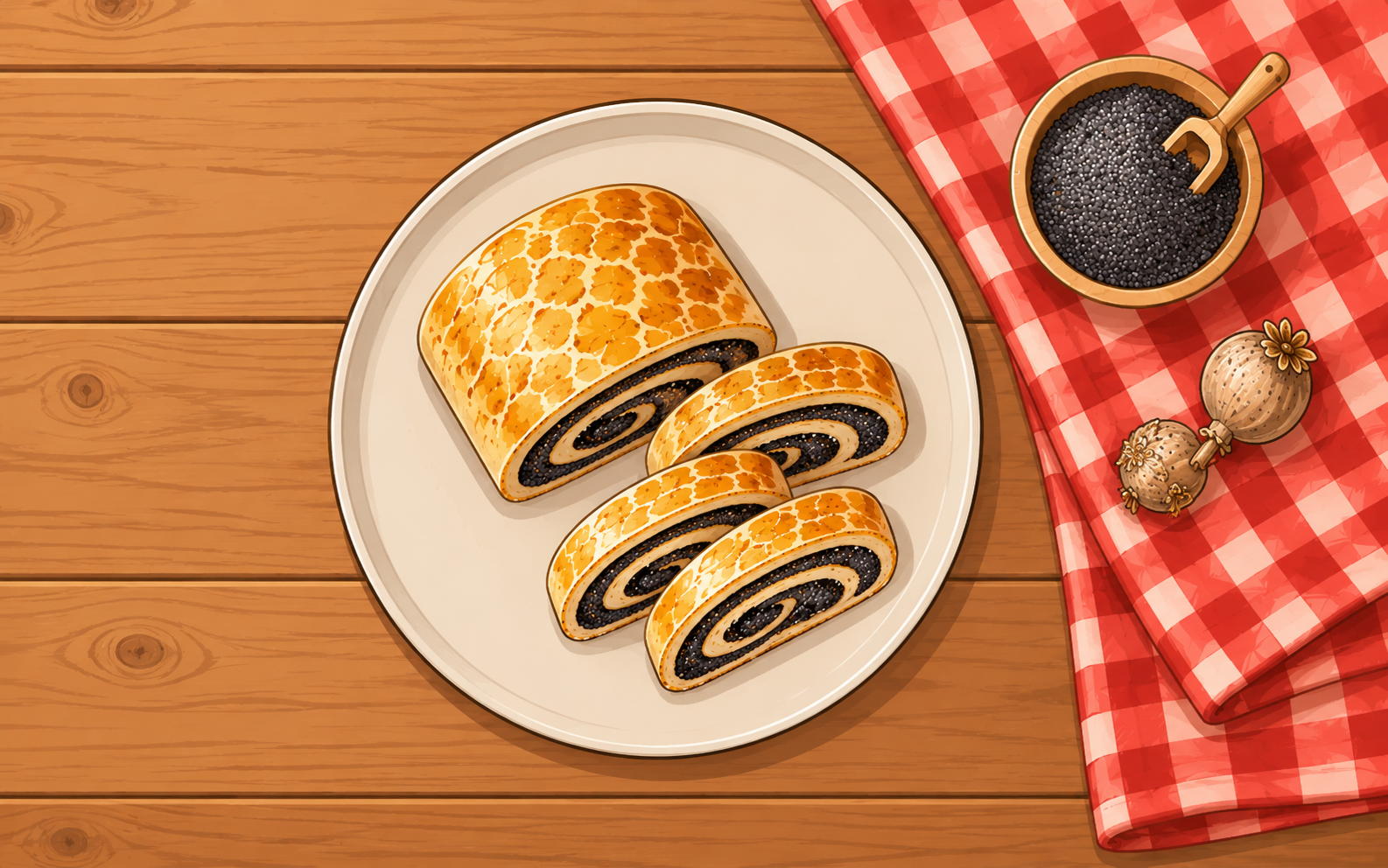
„Kto si prosí koláč? Upiekla som makovník.“
„Ja! Milujem makovník,“ said Peter.
„Aj ja milujem makovník,“ said Jana.
„Nepýtaj sa a nalož, mamka!“ said Ivan and winked at me.
I guessed it meant: Stop asking and put it on the plate already.
I smiled and took the first bite.
Hmmmm, poppy-seed cake.
„Makovník je výborný. Ešte môžem?“
I could not resist, even though I thought I would not be able to move from the chair afterwards.
„No jasné!“
Eva immediately put another piece on my plate. There is no greater praise for a Slovak mum than children and guests leaving with an empty plate—or asking for more. She looked absolutely delighted.
„Chutilo ti jedlo, moja? Je to dobré?“
„Nie je to dobré. Je to vynikajúce!“ I exclaimed.
„Ešte si dáme po poháriku na zdravíčko.“
Ivan took out little glasses and poured us all slivovica. He filled Janka’s glass with džús.
„Na zdravie!“
„A do dna!“ said Peter and gave me a little peck.
I hope I’m not going to get drunk…
Although I had already asked for vodka instead of water, surely nothing else could go wrong.
POĎME NA TO!
❓Quiz Time
📘Slovník (Phrase Glossary)
| Slovak Phrase | English Meaning | Explanation |
|---|
| Dáš si…? | Would you like…? | Offering food or drink |
| Nie, ďakujem. | No, thank you. | Polite refusal |
| Máš rada…? | Do you like…? | Asking a woman if she likes something |
| Ja ju nemám rada. | I don’t like it. | Expressing dislike |
| Kto si prosí…? | Who would like…? | Offering food to a group |
| Chutilo ti? | Did you enjoy it? | Asking if someone liked the food |
| Na zdravie! | Cheers! | Toasting |
| A do dna! | Bottoms up! | Finish your drink |
| Poď sem. | Come here. | Calling someone over |
📚 Slovíčka (Vocabulary List)
Food & Drinks
| Slovak | English |
|---|---|
| polievka | soup |
| cesnačka | garlic soup |
| chlieb | bread |
| chlebík | little bread / bread (diminutive) |
| kurací rezeň | chicken schnitzel |
| ryža | rice |
| zemiaky | potatoes |
| hranolky | chips / fries |
| voda | water |
| vodka | vodka |
| džús | juice |
| pivo | beer |
| víno | wine |
| koláč | cake |
| makovník | poppy-seed cake |
| slivovica | plum brandy |
Useful Adjectives
| Slovak | English |
|---|---|
| hladný / hladná | hungry |
| smädný / smädná | thirsty |
| milý / milá | nice |
| čerstvý | fresh |
| výborný | excellent |
| vynikajúci | outstanding |
| hnusný | disgusting |
🧠 Cultural Note: Diminutives
Slovaks love making words smaller and friendlier.
| Normal | Diminutive |
|---|---|
| chlieb | chlebík |
| voda | vodička |
| káva | kávička |
| víno | vínko |
🧠 Grammar explained – BYŤ (To Be)
👉 Why is this verb important?
The verb byť (to be) is one of the most common verbs in Slovak.
If Slovak verbs were a family, byť (to be) would be the nosy neighbour.
It shows up everywhere.
You use it to say:
– who you are
– where you are from
– how you feel
– whether you are hungry enough to eat an entire Slovak dinner
Sarah used it all evening:
Som hladná. → I am hungry.
Som smädná. → I am thirsty.
Tvoja sestra je milá. → Your sister is nice.
Sme hladní. → We are hungry.
Without byť, Sarah would not be able to explain much beyond pointing at food and hoping for the best.
🔨 How It Works
Unlike many Slovak verbs, byť is a rebel.
The forms do not follow a neat pattern, so unfortunately you cannot simply learn one ending and guess the rest.
You need to memorise them.
| Person | Slovak | English |
|---|---|---|
| Ja | som | I am |
| Ty | si | You are |
| On/Ona/Ono | je | He/She/It is |
| My | sme | We are |
| Vy | ste | You are |
| Oni | sú | They are |
🟣POROVNAJ (compare with the verb VOLAŤ sa from the episode 1)
| Person | Form | Root + Ending |
|---|---|---|
| Ja | volám sa | vol- + -ám |
| Ty | voláš sa | vol- + -áš |
| On / Ona | volá sa | vol- + -á |
| My | voláme sa | vol- + -áme |
| Vy | voláte sa | vol- + -áte |
| Oni | volajú sa | vol- + -ajú |
💡 Grammar Tip: Bacha na to!
👉 When somebody asks your name, Slovaks often use two different answers:
„Ako sa voláš?“
Volám sa Sarah.
(My name is Sarah.)
Som Sarah.
(I am Sarah.)
Both are correct and very common. You’ll hear both in everyday conversations.
🎯 Quick tip: If you’re not sure which one to use, Volám sa + name is always a safe choice for beginners.
🟣 3. Have you noticed? We also saw a very important verb MAŤ (to have)
| Person | Form | Root + Ending |
|---|---|---|
| Ja | mám | ma- + -m |
| Ty | máš | ma- + -š |
| On / Ona | má | ma- + -á |
| My | máme | ma- + -me |
| Vy | máte | ma- + -te |
| Oni | majú | ma- + -jú |
🧠 Grammar explained – hladná, hladný, hladní
💡 Why Is Sarah hladná, Peter hladný, but They Are hladní?
Welcome to one of Slovak’s favourite hobbies: changing word endings. 😄 And showing off!
In Slovak, adjectives change depending on who you are talking about.
Sarah says:
Som hladná.
I am hungry.
Peter says:
Som hladný.
I am hungry.
Jana and Peter say:
Sme hladní.
We are hungry.
Same idea, different endings.
Singular vs Plural
| English | Female | Male | Plural |
|---|---|---|---|
| hungry | hladná | hladný | hladní |
| thirsty | smädná | smädný | smädní |
| tired | unavená | unavený | unavení |
| nice | milá | milý | milí |
| happy | šťastná | šťastný | šťastní |
🎯 Bacha na to!
When a group includes at least one man, Slovak normally uses the masculine plural form:
Sarah + Jana =
Sme hladné. (all female)
Sarah + Peter =
Sme hladní. (mixed group)
That’s why Jana says:
„Sme hladní.“
because she is talking about herself and Peter.
Welcome to Slovak grammar. The endings change almost as often as the menu. It feels chaotic at first, but there is a logic to the madness—and you’ll start seeing the patterns soon. 😄
🤓 Now you try it!
🎯 What Did You Learn in this Slovak graded story?
In this beginner Slovak graded story, you learned how to talk about food, make polite requests using prosím si, use the verb byť (to be), and understand common family dinner conversations. You also learned useful Slovak phrases for accepting food, talking about likes and dislikes, and making a toast at the table.
Still think Slovak is just “a bit like Czech”? 🍻 Episode 3 will test that theory.
In Ideme na pivo?, Sarah meets Peter’s friends in a Slovak pub and quickly realises that understanding the language is one thing… surviving the social chaos is something else entirely. Between fast speech, inside jokes, and unexpected opinions, she’ll need more than vocabulary to keep up.
You’ll practise mám rád / mám rada, learn real social phrases, and see how Slovak actually behaves in the wild — loud, fast, and slightly chaotic.
👉 Continue to Episode 3 and join the pub table (if you dare).
