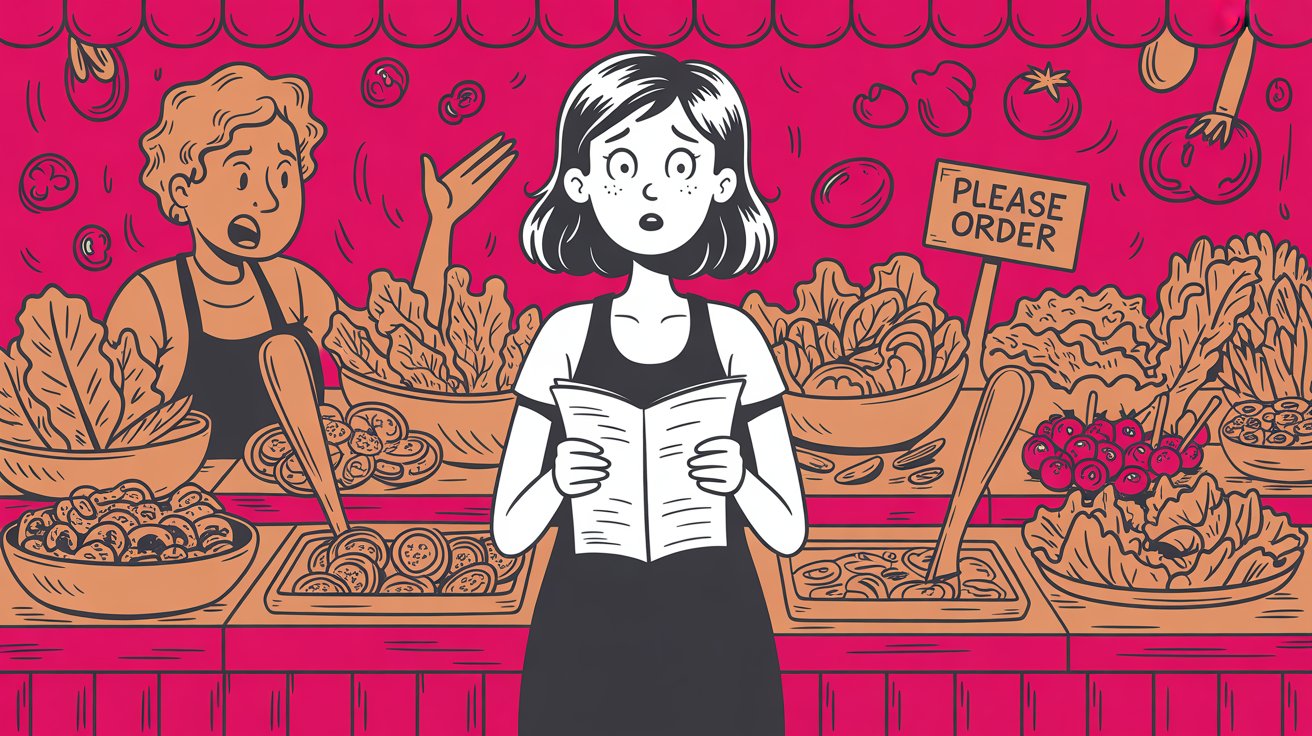
Lost in Translation: The Sandwich Saga in Northern Ireland
I am standing in a tiny petrol station shop somewhere in Northern Ireland. It’s my first week in this new country, and my nerves are doing cartwheels. I’m here to work as an au pair and, hopefully, to improve my English — which, right now, feels like it’s on life support.
The family I’m staying with has stopped for a quick bite. I want to order on my own to practice. Behind the counter, a young assistant beams a friendly smile at me.
Time for food
“Hi there! Would you like a roll?” she asks.
A roll? What kind of roll? Like a toilet roll? She points at the bread selection. Oh, right — a sandwich.
I stare at the glass display. Bread, cheese, meats, sauces — my brain has turned into a blank whiteboard.
Then she starts firing questions like a game show host:
“What kind of bread? White, brown, or seeded?”
“Cheese?”
“Toasted?”
“What salad? Lettuce, tomato, onion, cucumber?”
“Sauce? Mayo, ketchup, sweet chilli?”
This feels less like ordering food and more like an interrogation by a sandwich CIA.
My brain is screaming: HELP! I only know two answers: “Yes, please” and “No, thank you.”
So I guess.
“Uhm… yes, please,” I say, flashing a nervous smile.
“Cheese?”
“Yes, please.”
“Toasted?”
“Yes, please.”
“Salad?”
“No, thank you.”
“And sauce?”
“Uhm… yes, please.”
The assistant nods like I just cracked the sandwich code, then gets to work.
I have no clue what’s coming
She hands me the roll — but this isn’t just any bread roll. It’s the kind of roll that looks like it survived a minor apocalypse. The bread is white, crusty on the outside but suspiciously squishy inside, like it had a secret life as a sponge. It’s toasted just enough to be crunchy, but also a bit burnt in one corner — a crispy little black badge of honor.
Inside, there’s melted cheese oozing out, but the main filling is plain pasta. On a sandwich. And on top? A generous slathering of ketchup, like someone accidentally grabbed the kids’ craft glue instead.
It looks less like lunch and more like a sad science experiment gone wrong.
But I pay and walk out.
The mother of the family — my future boss — watches me, eyes wide.
Seriously?
“Is that what you wanted?” she asks kindly.
I smile awkwardly.
“Uhm… yes. I like it,” I lie. I am a bold-faced liar.
I take a bite.
Disgusting. Worse than my student attempts at cooking.
But I don’t want to make a bad impression.
So I smile and say, “It’s delicious.”
This is me: a university graduate with an A in English, who just landed in Northern Ireland — and still can’t order a simple sandwich without a panic attack.
I make a mental note: Must study really, really hard… or I’ll starve.
📘 Phrase Glossary
| Phrase | Meaning |
|---|---|
| nerves are doing cartwheels | Feeling extremely nervous. |
| on life support | Barely functioning or very weak (used humorously here for language skills). |
| blank whiteboard | A completely empty mind — forgetting everything in the moment. |
| interrogation by a sandwich CIA | A playful exaggeration — the questions felt intense and overwhelming. |
| survived a minor apocalypse | Looks rough, messy, or damaged — very unappetizing. |
| crispy little black badge of honor | A burnt spot on food, described humorously like a badge or prize. |
| sad science experiment gone wrong | Something that looks strange or disgusting. |
| bold-faced liar | Someone who lies confidently or without hesitation (used jokingly). |
| Must study really, really hard… | A mental note to oneself, showing determination (with humor). |
Present Tenses Explained
A friendly guide to present simple, continuous, and perfect — featuring examples from real life abroad.
Subject + verb (+ s for he/she/it)Examples: I work, He asks, She likes
Subject + am/is/are + verb + -ingExamples: I am standing, He is asking, They are talking
Right: “I am going to the shop.” (present continuous for the action happening now)
Subject + have/has + past participleExamples: I have finished, He has left, They have arrived
Right: “Have you finished?” (present perfect emphasises the present result)
Quick Comparison
Present Simple
“I work here.”
Habitual, regular, or permanent.Present Continuous
“I am working here.”
Right now, in progress, temporary.Present Simple
“I ask questions.”
This is what I typically do.Present Continuous
“I am asking questions.”
I’m doing this at this moment.Present Continuous
“They are leaving.”
In progress now (or about to happen).Present Perfect
“They have left.”
They left, and the result is: they’re gone.📚 Ready to practise your English?
Log in or sign up below for a free Abroadien Club account to unlock the complete interactive practice set for this story, including reading comprehension, vocabulary, grammar, word building, writing activities with instant feedback, and progress tracking.
